
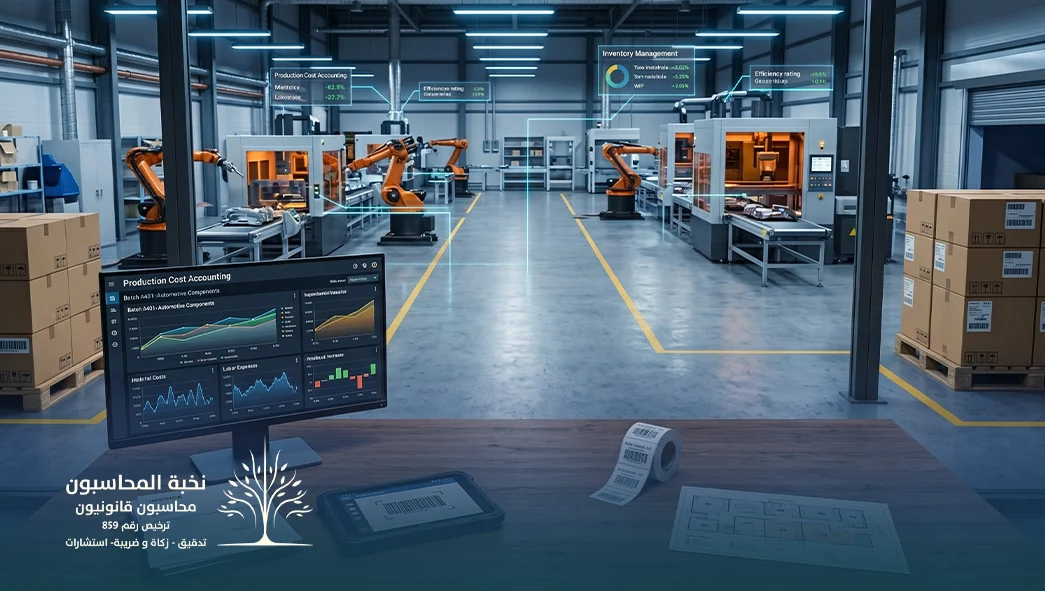
Manufacturing companies are among the key drivers of Saudi Arabia’s economy, serving as the foundation of local production and the industrial transformation envisioned under Vision 2030.
However, managing manufacturing businesses extends far beyond production operations. Manufacturing accounting plays a critical role in determining product costs, measuring profitability, and controlling waste. Unlike trading businesses that simply purchase and sell finished goods, manufacturers face complex accounting challenges associated with transforming raw materials into finished products.
In this article, we explore the fundamentals of manufacturing accounting and how a specialized accounting system transforms financial data into strategic decisions that support growth and expansion.
What Is Manufacturing Accounting?
Manufacturing accounting is a specialized accounting system that focuses primarily on cost accounting. It is designed to track and record all costs associated with the manufacturing process, from purchasing raw materials and managing labor costs to allocating machine expenses and calculating the actual production cost per unit.
Rather than simply recording expenses, manufacturing accounting serves as a management tool that prevents resource waste and enables businesses to price products competitively while maintaining profitability.
Key Components of a Manufacturing Accounting System
To ensure financial accuracy and effective control, a manufacturing accounting system should include the following elements:
Raw Material Management
Monitor the movement of raw materials from suppliers to warehouses and production lines, ensuring adequate availability without excessive stock while accurately recording material costs for each production order.
Production Accounting
Track every stage of production, including Work in Progress (WIP), by allocating direct materials, labor, and overhead costs until products become finished goods.
Product Costing
Calculate the actual cost of each unit by combining direct and indirect production costs, providing a reliable basis for pricing decisions.
Waste and Scrap Control
Monitor production waste and allowable losses, whether normal or abnormal, analyze their causes, and implement corrective actions to minimize profit leakage.
Fixed Asset Management
Maintain detailed records for machinery and equipment, including acquisition costs, accumulated depreciation, and maintenance expenses to ensure accurate financial reporting.
Payroll and Direct Labor
Link production workers’ wages to actual working hours, enabling management to measure productivity and allocate labor costs accurately to production orders.
Manufacturing Overhead
Allocate indirect costs—such as electricity, rent, maintenance, and depreciation—across production departments using appropriate cost allocation methods.
Financial and Management Reporting
Generate regular dashboards and reports that provide management with insights into financial performance, production efficiency, pricing decisions, and expansion opportunities.
The Role of Cost Accounting in Improving Profitability
Cost accounting serves as the operational compass that guides manufacturers toward maximum profitability by analyzing production performance through several key areas.
Direct Costs
Accurately track raw materials and direct labor to ensure each product bears its fair share of production costs.
Indirect Costs
Control manufacturing overhead such as electricity, equipment maintenance, depreciation, and production supervision while allocating costs fairly across cost centers.
Cost Centers
Divide the factory into production and service departments—such as assembly, packaging, and maintenance—to measure each department’s performance and identify inefficiencies.
Unit Cost
Determine the true cost per unit, providing the foundation for effective pricing strategies and sustainable profit margins.
Variance Analysis
Compare standard costs with actual costs to identify cost overruns and address operational inefficiencies promptly.
Production Decision-Making
Provide management with reliable cost data to answer strategic questions such as:
- Should we manufacture or outsource components?
- Is it worthwhile to add another production line?
- Should an unprofitable product be discontinued?
Inventory Management in Manufacturing Accounting
Inventory represents significant capital tied up in manufacturing operations and must be managed carefully. Professional manufacturing accounting requires a comprehensive inventory lifecycle rather than periodic stock counts alone.
Raw Material Inventory
Ensure sufficient raw material availability without overstocking, which can lead to deterioration or obsolete inventory.
Work in Progress (WIP)
Properly value partially completed products by capturing accumulated production costs before manufacturing is completed.
Finished Goods Inventory
Maintain accurate records to ensure the cost of goods sold (COGS) aligns with sales while supporting timely customer fulfillment.
Continuous Inventory Control
Implement perpetual inventory systems to provide real-time stock visibility and stronger internal controls than periodic inventory methods.
Loss Monitoring
Detect unexplained losses caused by theft, damage, or poor storage conditions and address them immediately.
Inventory Turnover
Measure how quickly inventory converts into sales, helping improve cash flow and reduce excess stock.
Integration Between Inventory, Production, and Accounting
Digitally connect inventory transactions, production orders, and accounting systems to improve cost accuracy and financial reporting.
The Role of Modern Accounting Systems in Manufacturing
Digital transformation has shifted manufacturing accounting from paper-based records to integrated Enterprise Resource Planning (ERP) systems that connect all business functions.
Warehouse Integration
Maintain accurate inventory balances in real time while preventing stock shortages and overstocking.
Purchasing Integration
Automate purchase orders based on actual production demand to ensure uninterrupted material supply.
Sales Integration
Link customer orders directly with available production to accelerate delivery and collections.
Real-Time Production Monitoring
Track production stages and waste instantly, enabling management to respond quickly to operational issues.
Cost Reporting
Generate automatic reports comparing actual and standard production costs to improve decision-making.
Executive Dashboards
Present key performance indicators (KPIs) visually, allowing management to monitor factory performance at a glance.
Decision Support
Provide timely and reliable data that supports strategic decisions based on measurable business performance rather than assumptions.
How Specialized Accounting Services Support Manufacturers
Working with a specialized accounting advisory firm such as AOCPA helps manufacturers build a financial structure that maximizes profitability through:
- Designing cost accounting systems to accurately calculate unit costs.
- Establishing production and service cost centers.
- Preparing IFRS-compliant financial statements.
- Implementing strong internal controls to protect factory assets and reduce waste.
- Producing detailed financial and operational reports.
- Ensuring compliance with ZATCA regulations.
- Delivering financial analysis to evaluate performance and growth opportunities.
- Supporting external audit processes with complete documentation.
- Developing strategies to reduce costs and improve manufacturing profitability.
At AOCPA, we have extensive experience supporting manufacturing businesses across Saudi Arabia. Contact us today to discuss your accounting requirements and improve your factory’s financial performance and profitability.
Frequently Asked Questions
What is the difference between financial accounting and manufacturing cost accounting?
Financial accounting focuses on preparing financial statements for external users such as banks and tax authorities, while manufacturing cost accounting is an internal management tool used to analyze production costs, control expenses, and improve operational performance.
Why is manufacturing inventory more complex than retail inventory?
Retail businesses manage finished goods ready for sale, whereas manufacturers manage three inventory categories: raw materials, work in progress (WIP), and finished goods, requiring more sophisticated accounting and operational controls.
How are manufacturing overhead costs allocated?
Indirect costs are allocated using logical cost drivers such as direct labor hours, machine hours, or production space to ensure each product receives its fair share of overhead expenses.
Why are standard costing systems important?
Standard costing establishes expected production costs. Comparing these with actual costs helps management identify waste related to materials, labor, or utilities and implement corrective actions quickly.