

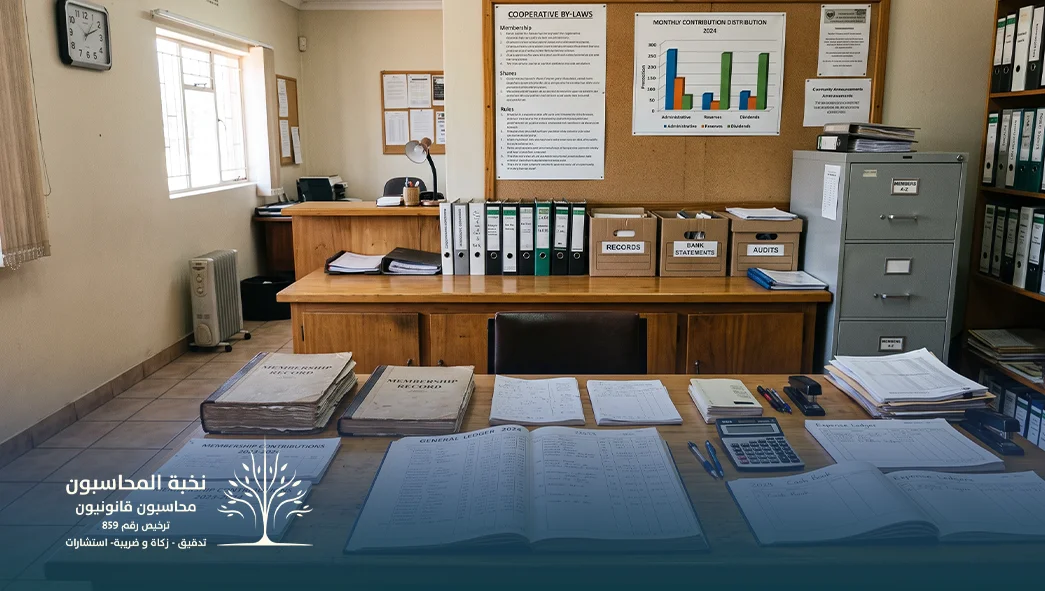
Cooperative associations in Saudi Arabia face accounting challenges that differ in nature from those encountered by many commercial entities. The process involves more than simply recording revenue and expenses; it also requires managing the association’s resources, capital, and members’ contributions, ensuring accurate financial reporting, complying with regulatory requirements, and providing reliable information that enables the Board of Directors and General Assembly to make sound decisions.
With the requirements of the Cooperative Associations Law and its Implementing Regulations, along with the need for effective financial oversight, cooperative association accounting becomes an essential part of maintaining the association’s stability and managing its resources effectively. But how should accounts be properly organized? What are the key financial reports and accounting entries? And how should an association prepare for a financial audit?
In this guide, we provide a practical overview of the key accounting and financial control aspects that cooperative associations in Saudi Arabia need to consider.
What Is Cooperative Association Accounting?
Cooperative association accounting is the process of recording, classifying, summarizing, and analyzing the financial transactions carried out by an association. This helps determine its operating results and financial position while providing reliable information to relevant stakeholders.
The role of accounting is not limited to recording revenue and expenses. It also includes monitoring assets, liabilities, capital, and member-related accounts, performing reconciliations and adjustments, and preparing financial reports and annual accounts in accordance with the applicable accounting framework and regulatory requirements.
The more accurate and up to date the accounting data is, the better the association can monitor its resources, identify discrepancies, strengthen financial controls, and prepare for audits without having to correct a large number of errors at year-end.
The Difference Between Cooperative Association Accounting and Corporate Accounting
To understand cooperative association accounting more accurately, it is important to distinguish it from corporate accounting. Each type of entity differs in its nature, objectives, and certain aspects related to membership, capital, financial results, and oversight.
| Comparison | Cooperative Association | Commercial Company |
|---|---|---|
| Primary Objective | To achieve economic or social benefits for its members in accordance with cooperative objectives and the association’s bylaws. | To conduct commercial activities and generate returns for owners or shareholders according to the company’s nature and objectives. |
| Capital | Linked to members’ contributions and determined by the association’s bylaws and applicable regulations. | Structured according to the company’s approved capital framework, contributions from owners or shareholders, and other financing sources. |
| Membership and Voting Rights | Membership and voting rights are governed by cooperative principles, applicable rules, and the association’s bylaws. | Owners’ or shareholders’ rights depend on the type of company and the provisions of applicable regulations, articles of incorporation, or bylaws. |
| Treatment of Financial Results | Surplus or financial results are treated in accordance with the Cooperative Associations Law, its regulations, and the association’s bylaws. | Profits, losses, and dividend distributions are treated in accordance with the Companies Law and decisions approved by the relevant authorities within the company. |
| Oversight and Audit | Subject to the regulatory, supervisory, and accounting requirements applicable to cooperative associations, in addition to oversight by members and competent authorities. | Subject to the regulatory, accounting, and supervisory requirements applicable to the company’s type and nature of business. |
This distinction means that cooperative association accounting should not be managed as an exact replica of corporate accounting. Instead, it must take into account the nature of the association, members’ rights, reporting and oversight requirements, and the regulatory framework applicable to it.
How Is Cooperative Association Accounting Carried Out?
The accounting cycle within a cooperative association involves a series of interconnected stages, beginning with financial documentation and ending with financial reports and annual accounts.
Preparing the Chart of Accounts
The chart of accounts forms the foundation of the accounting system. It classifies accounts in a way that reflects the association’s activities, including assets, liabilities, capital, revenue, expenses, and other accounts related to the nature of its operations.
A well-organized chart of accounts helps standardize accounting entries, reduce classification errors, and simplify financial reporting.
Recording Capital and Member-Related Transactions
The association needs clear records of transactions related to capital, members’ contributions, and any financial transactions involving members. Each transaction should be supported by appropriate documentation, with balances capable of being reconciled when necessary.
Recording Revenue and Expenses
Revenue should be recorded according to its source and nature, while expenses should be recorded in the appropriate accounts and supported by invoices, contracts, approvals, and other relevant documentation.
The accuracy of an expense amount alone is not sufficient. Correct accounting classification, proper documentation, and approval in accordance with internal authorization procedures are also essential to maintaining reliable financial records.
Monitoring Assets and Liabilities
Cooperative association accounting includes recognizing and tracking assets, recording liabilities, verifying the accuracy of balances, and carrying out the necessary reconciliations and adjustments on a regular basis.
Adjustments and Accounting Close
Before preparing financial accounts and reports, the association should review its accounts and make all necessary adjustments, including bank reconciliations, balance reviews, examination of suspense accounts, and verification that all transactions relating to the financial period have been fully recorded.
What Financial Reports Does a Cooperative Association Need?
Financial reports help a cooperative association understand its financial position, operating results, resources, and obligations. They also provide the Board of Directors and General Assembly with reliable information for oversight and decision-making.
The names and components of financial statements and reports may vary depending on the accounting framework and regulatory requirements applicable to the association. However, financial accounts generally include information relating to:
- Financial position: Shows the association’s assets, liabilities, and items related to members’ equity at a specific date.
- Operating results: Shows revenue, expenses, and the results of activities during the financial period in accordance with the applicable accounting treatment.
- Cash flows: Shows cash inflows and outflows and helps assess the association’s ability to manage liquidity and meet its obligations.
- Notes to the financial statements: Provide additional information about accounting policies, significant items, and details necessary to properly understand the financial statements.
- Internal financial reports: Such as reports on revenue, expenses, balances, receivables and payables, and liquidity, which help management monitor financial performance throughout the year rather than waiting until year-end.
The preparation of annual accounts is linked to regulatory requirements, including presenting the association’s accounts and supporting documents to the auditor before the General Assembly meeting. Therefore, financial reporting is an ongoing tool for monitoring performance, strengthening oversight, and preparing for the audit process.
What Are the Key Accounting Entries for Cooperative Associations?
Accounting entries vary according to the association’s activities and the nature of each transaction, but recurring transactions may include:
- Recording capital and members’ contributions.
- Recording revenue and collections.
- Recording operating and administrative expenses.
- Purchasing and recognizing assets.
- Recording and settling liabilities.
- Recording accounting adjustments at the end of the period.
It is not advisable to use a standardized accounting entry for a transaction based solely on its name. The nature of the transaction, its supporting documentation, and the appropriate accounting treatment should first be determined.
The Importance of Auditing Cooperative Associations
There is a fundamental difference between preparing accounts and auditing them. Accounting produces records, accounts, and reports, while a financial audit involves examining relevant information and evidence to reach a professional conclusion in accordance with applicable auditing standards and requirements. The importance of cooperative association auditing includes:
- Enhancing the reliability of financial information.
- Examining evidence supporting balances and transactions.
- Assessing the risks of material misstatement.
- Identifying certain errors or deficiencies relevant to the audit.
- Supporting financial transparency and accountability.
- Issuing the external auditor’s report on the accounts and financial statements in accordance with the audit scope, professional standards, and applicable regulatory requirements.
An audit is not merely about searching for errors; it is an important component of the overall governance and financial control framework.
How Should a Cooperative Association Prepare for a Financial Audit?
Audit preparation begins well before the audit date. Maintaining organized records and performing reconciliations throughout the year reduces discrepancies and missing documentation when the auditor begins their work. Key procedures that support audit readiness include:
- Completing the recording of financial transactions.
- Performing bank reconciliations.
- Reviewing account balances and receivables and payables.
- Organizing invoices, contracts, and supporting documents.
- Updating and reconciling the fixed asset register.
- Preparing account statements and required confirmations.
- Preparing accounts, financial statements, and financial reports.
- Reviewing previous audit observations and ensuring that necessary corrective actions have been taken.
Maintaining a complete financial file makes it easier for the auditor to obtain the required evidence and reduces delays caused by missing documentation or unexplained discrepancies.
Common Accounting Errors Cooperative Associations May Encounter
Some accounting problems do not result from one major transaction but instead develop through the accumulation of smaller errors throughout the year. Common issues include:
- Recording transactions without sufficient supporting documentation.
- Delays in recognizing revenue or expenses.
- Classifying transactions under inappropriate accounts.
- Failing to perform bank reconciliations regularly.
- Maintaining old balances without proper analysis or follow-up.
- Weak monitoring of member-related accounts.
- Failing to update the fixed asset register.
- Inadequate segregation of financial duties and authorities.
- Postponing account reviews until year-end.
Regular account reviews therefore help identify problems early, before they affect the quality of annual financial reporting.
How Does Internal Control Help Protect the Association’s Funds?
An effective accounting system requires a strong internal control framework to support it. This includes defining authorities, separating the execution, approval, and recording of transactions as far as possible, carrying out regular reconciliations and inventory counts, and monitoring bank accounts.
Written financial policies, structured expense approval procedures, and controlled access permissions within the accounting system also help reduce errors and strengthen accountability.
The purpose of internal control is not to make procedures more complicated, but to establish a clear process that makes it possible to determine who executed a transaction, who approved it, and how it was recorded and documented.
When Does a Cooperative Association Need Accounting Support or an Auditor?
A cooperative association may require accounting expertise or a licensed auditor in several situations, including:
- At establishment: To set up the accounting system and an appropriate chart of accounts.
- At the end of the financial year: When annual accounts and financial statements need to be prepared and subsequently audited by an external auditor in accordance with applicable requirements.
- When applying for grants or loans: To provide approved financial reports to grant providers or lenders.
- When there are concerns about the financial position or the effectiveness of internal controls.
- When management or the treasurer changes: To ensure a smooth transfer of financial data.
How to Choose an Accounting and Audit Firm for a Cooperative Association
Choosing the right accounting and audit firm should not depend solely on the cost of the service. It should also consider the firm’s ability to understand the association’s nature and its financial and regulatory requirements, as well as its ability to provide professional services that improve reporting quality and enhance the reliability of financial information. Therefore, it is important to consider the following criteria:
- Professional licensing: Ensure that the firm and its practitioners meet the professional licensing requirements necessary to provide the required services in Saudi Arabia.
- Audit experience: Look for practical experience in auditing financial statements and reports, examining records and supporting documents, and addressing accounting observations.
- Understanding of Saudi regulations: The firm should be familiar with the laws, regulations, and professional and regulatory requirements relevant to the association’s activities and should keep up with any updates.
- Knowledge of cooperative associations: Understanding the nature of membership, capital, financial transactions, and control requirements specific to cooperative associations helps ensure more accurate handling of their accounts.
- Clear scope of work: The required services, responsibilities of each party, expected deliverables, and timeframe should be clearly defined from the outset.
- Quality of communication and reporting: Choose a firm that communicates its observations and findings clearly and professionally, helping management understand areas that require corrective action or improvement.
- Independence and compliance with professional standards: Particularly in audit engagements, independence, objectivity, and adherence to professional standards are fundamental to the reliability of the auditor’s work and report.
Successful cooperative association accounting does not depend solely on preparing accounts at year-end. Instead, it requires an integrated financial cycle that begins with proper documentation and accurate recording, continues through reconciliations, controls, and financial reporting, and concludes with accounts and financial statements that are ready for audit.
If your association needs support in organizing its accounts, reviewing its financial reports, or preparing for audit and assurance procedures, the Al Nokhba Company team can assist you with accounting and professional services that take into account the nature of cooperative associations and the regulatory and professional requirements in Saudi Arabia, helping improve the accuracy of financial information and enhance the association’s audit readiness.
Contact Al Nokhba Company to discuss your association’s needs and determine the appropriate professional service.
Frequently Asked Questions About Cooperative Association Accounting
Is a Cooperative Association Required to Appoint an Auditor?
The auditing of cooperative associations is subject to the requirements set out in the Cooperative Associations Law, its Implementing Regulations, and other relevant regulations and instructions. Therefore, the specific obligations applicable to the association and its circumstances should be verified.
Who Is Responsible for Preparing a Cooperative Association’s Accounts?
The Board of Directors has specific financial responsibilities under the applicable regulations, while accounting activities are carried out by the responsible officers or professionals assigned to them. Roles and responsibilities remain governed by the approved organizational structure and regulations.
Is Cooperative Association Accounting Different From Charitable Association Accounting?
Yes. There are differences in regulatory and economic nature, sources of funds, and transactions. Therefore, the accounting and regulatory framework applicable to each entity should be identified rather than assuming that the same accounting treatment applies to both.
What Is the Difference Between an Accountant and an Auditor?
An accountant records and processes transactions and prepares accounts and reports, while an independent auditor examines the financial statements and related evidence and issues an audit report in accordance with professional standards and the scope of the audit.
How Can an Association Reduce Errors Before a Financial Audit?
By recording transactions consistently, maintaining proper documentation, performing regular reconciliations and adjustments, reviewing balances, and avoiding waiting until year-end to identify accounting issues.