
Types of financial statements are among the most important tools used by companies and organizations to measure financial performance, evaluate financial position, and make more informed managerial and investment decisions. Regardless of the size of a business or the industry in which it operates, financial statements remain the primary source for understanding financial results and analyzing strengths, challenges, and future opportunities.
In this article, we explore the concept of financial statements, the main types of financial statements, the role of each statement in financial performance analysis, how they are properly prepared, and the most common mistakes to avoid.
First: What Are Financial Statements?
Financial statements are accounting reports prepared over a specific period to present an organization’s financial position and operating results in an organized manner and in accordance with approved accounting standards.
These reports provide a clear picture of revenues, expenses, assets, liabilities, cash flows, and equity, enabling stakeholders to assess financial performance and make informed decisions based on accurate and reliable data.
Financial statements are considered one of the fundamental pillars of financial management, governance, and internal control across organizations of all sizes and sectors.
Second: Main Types of Financial Statements
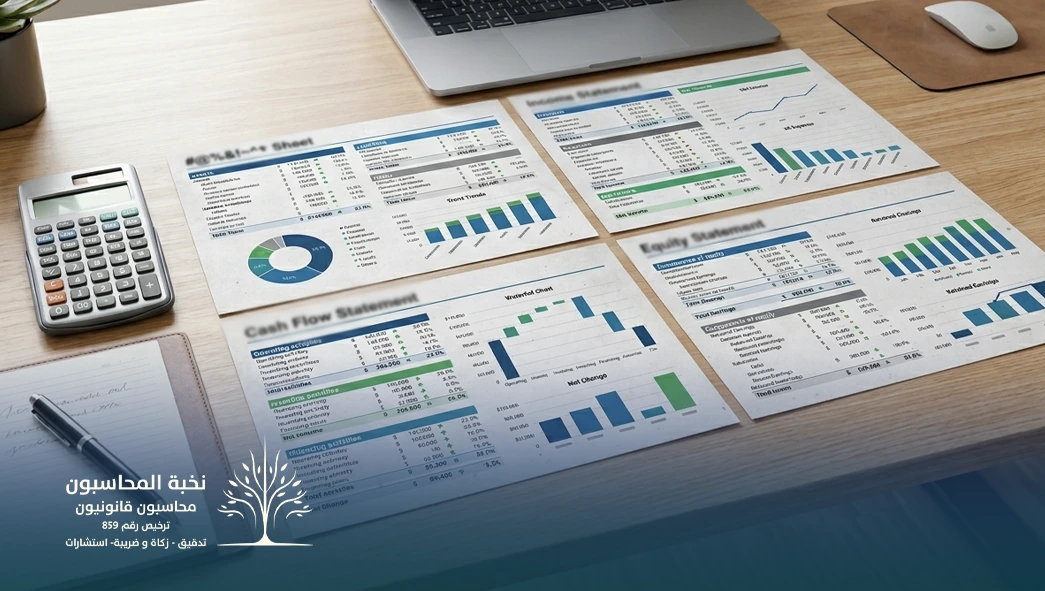
Financial statements are generally divided into four primary statements, each serving a distinct role in analyzing an organization’s financial position.
1. Statement of Financial Position
Also known as the Balance Sheet, this statement presents the financial position of the organization at a specific date.
It includes:
- Assets
- Liabilities
- Equity
This statement helps identify the resources owned by the company, its obligations, and the strength of its financial position and ability to meet future commitments.
2. Income Statement
The Income Statement is used to measure business performance during a specific financial period by presenting:
- Revenues
- Expenses
- Net profit or loss
It is one of the most widely used financial statements for evaluating operational performance, profitability, and resource management efficiency.
3. Cash Flow Statement
The Cash Flow Statement illustrates the movement of cash into and out of the organization during a specific period.
Cash flows are typically classified into:
- Operating activities
- Investing activities
- Financing activities
This statement helps assess the organization’s ability to generate sufficient liquidity to meet obligations and support future operations.
4. Statement of Changes in Equity
This statement explains changes in owners’ equity during the financial period.
It includes:
- Retained earnings
- Dividend distributions
- Capital increases or decreases
- Net results of operations
The statement provides clear insight into the development of equity and the reasons behind any changes.
Therefore, relying on a single financial statement is not sufficient for a complete financial assessment. All financial statements should be analyzed together to obtain a comprehensive and accurate view.
Third: Importance of Financial Statements for Companies and Investors
Financial statements are essential tools for decision-making both inside and outside organizations. They help in:
- Evaluating financial and operational performance
- Measuring profitability and efficiency
- Supporting future financial planning
- Identifying potential risks
- Enhancing transparency and accountability
- Facilitating access to financing and investments
- Supporting compliance with accounting standards and regulations
- Improving the quality of managerial and strategic decisions
Investors and financing institutions also rely on these statements to assess investment feasibility and risk levels associated with an organization.
Fourth: How Do Financial Statements Support Financial Performance Analysis?
Financial statement analysis transforms accounting figures into practical indicators that support decision-making.
By analyzing financial statement data, organizations can:
- Measure growth rates
- Evaluate operational efficiency
- Analyze liquidity levels
- Assess debt repayment capacity
- Identify profitability trends
- Evaluate asset management efficiency
- Compare performance with previous periods or competitors
For this reason, financial statement analysis is a crucial step toward understanding an organization’s actual condition rather than merely reviewing figures in isolation.
Fifth: How to Prepare Financial Statements Correctly
Preparing financial statements requires compliance with accounting standards and professional procedures to ensure data accuracy and reliability.
Key steps include:
- Recording all financial transactions accurately
- Classifying accounts according to their accounting nature
- Preparing the trial balance
- Performing necessary accounting adjustments
- Preparing the Income Statement
- Preparing the Statement of Financial Position
- Preparing the Cash Flow Statement
- Preparing the Statement of Changes in Equity
- Reviewing and verifying the statements before final approval
The more accurate the underlying data, the higher the quality and reliability of the resulting financial statements.
Sixth: Common Mistakes in Preparing Financial Statements
Certain errors can significantly impact the quality of financial reports and lead to inaccurate decisions.
Common mistakes include:
- Incorrect account classification
- Omitting financial transactions
- Failing to perform necessary accounting adjustments
- Errors in calculating revenues or expenses
- Poor documentation of supporting records
- Non-compliance with applicable accounting standards
- Delays in preparing financial reports
Regular reviews and support from qualified professionals help minimize these errors and improve reporting quality.
Seventh: Why Do Companies Need Accurate Financial Statements?
Managerial, investment, and financing decisions depend heavily on available financial information. Therefore, the accuracy of financial statements directly affects decision quality.
Accurate financial statements help companies:
- Improve financial planning
- Manage resources more efficiently
- Detect issues at an early stage
- Strengthen investor and partner confidence
- Comply with regulatory and tax requirements
- Support expansion and growth strategies
They also contribute to creating a clear financial picture that enables management to make more effective and sustainable decisions.
Why Choose Nukhbat Al-Muhasiboon for Financial Statement Preparation?
Nukhbat Al-Muhasiboon provides specialized accounting services that help companies prepare accurate financial statements in compliance with recognized professional standards.
Our services include:
- A team of certified accountants and auditors
- Extensive experience across multiple industries
- Preparation of financial statements in accordance with approved accounting standards
- Thorough review of financial records and data
- Clear reports that support decision-making
- Commitment to confidentiality and professionalism
- Ongoing support to improve financial performance
Our goal is to empower clients with reliable financial information that supports business success with confidence and efficiency.
Frequently Asked Questions
Who is responsible for preparing financial statements?
Financial statements are typically prepared by the finance department or qualified accountants within the organization. Specialized accounting firms may also be engaged to ensure accuracy and compliance with applicable standards.
Do financial statements differ between small and large companies?
The core financial statements are generally the same for all organizations. However, the level of detail and disclosure requirements may vary depending on company size and regulatory obligations.
How often are financial statements prepared?
Financial statements may be prepared monthly, quarterly, or annually depending on management requirements and regulatory obligations.
Can financial statements alone be relied upon for investment decisions?
Financial statements provide critical information, but they should be combined with market, operational, and economic analyses to achieve a more comprehensive investment perspective.
Which accounting standards are used in Saudi Arabia?
Most organizations in Saudi Arabia follow the International Financial Reporting Standards (IFRS) or the approved standards for small and medium-sized entities, depending on applicable regulatory requirements.
Conclusion
The types of financial statements form the foundation for understanding financial performance and making sound managerial and investment decisions. They provide accurate information for evaluating profitability, liquidity, and financial position while enhancing transparency, improving planning, and supporting sustainable growth.
If you are looking for a specialized firm to help prepare and analyze financial statements according to the highest professional standards, the team at Nukhbat Al-Muhasiboon offers comprehensive accounting services that ensure data accuracy and high-quality financial reporting. Contact us today for expert consultation that helps you manage your business efficiently and make financial decisions with greater confidence and professionalism.