
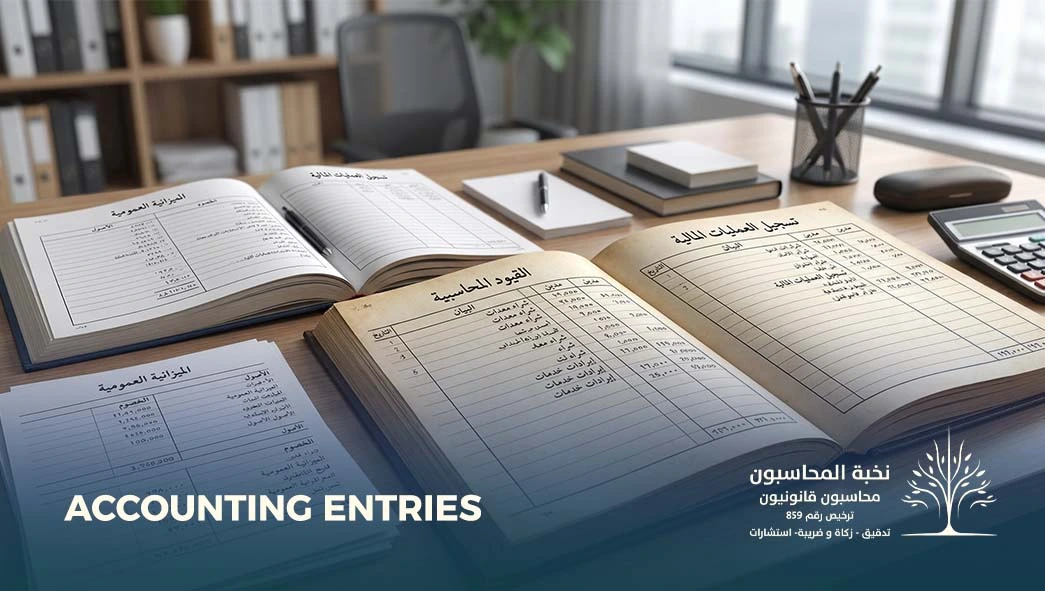
Accounting entries are the foundation upon which accounting systems in Saudi businesses are built. They represent the official method used to document financial transactions from the moment they occur until the preparation of financial statements.
The accuracy of financial reporting begins with properly recording daily entries in the accounting journal and ends with closing accounts at the end of the financial period. This ensures clarity in the financial position and compliance with the zakat and tax regulations applied in the Kingdom.
What Are Accounting Entries?
Accounting entries are organized accounting records used to document financial operations and transactions within a business. Each transaction is recorded according to the double-entry principle, involving a debit and a credit entry with equal values.
This method aims to accurately record revenues, expenses, assets, and liabilities, ensuring the reliability of financial data and making it easier to prepare, analyze, and review financial statements.
The Importance of Accounting Entries in Business Continuity and Performance
Accounting entries play a central role in the continuity and financial performance of organizations. Their importance goes beyond merely recording transactions and extends to regulatory, supervisory, and strategic aspects as follows:
Organizing Financial Records and Reducing Risks
Accounting entries help maintain well-organized financial records that accurately and transparently reflect all operations and activities. This reduces the risk of accounting errors, limits potential financial manipulation or zakat and tax evasion, and enhances compliance with regulations and laws applied in the Kingdom.
Monitoring Financial Performance and Enhancing Credibility
Accounting entries enable businesses to monitor their financial performance regularly. They form the basis for preparing the trial balance and financial statements that reflect the company’s true financial position. They also help detect errors and discrepancies early while strengthening the company’s credibility with investors, creditors, and regulatory authorities.
Supporting Sound Financial Decision-Making
Accounting entry data provides a comprehensive view of revenues, expenses, assets, and liabilities. This helps management prepare budgets, manage costs and inventory, allocate resources efficiently, analyze financial performance indicators, and make strategic decisions that support business growth and sustainability.
Since accounting entries represent the starting point of the accounting cycle, understanding their relationship with the accounting journal is essential to ensure that financial data flows correctly through the accounting system.
The Relationship Between Accounting Entries and the Accounting Journal
There is a direct and complementary relationship between accounting entries and the accounting journal. Accounting entries represent the technical format used to analyze financial transactions, while the accounting journal is the official record used to document these entries chronologically.
This relationship can be explained as follows:
-
Every financial transaction begins with an accounting analysis that results in an accounting entry.
-
The entry is recorded in the journal in chronological order, showing debit and credit accounts.
-
An accounting entry is not considered valid unless it is actually recorded in the journal.
-
Posting to the general ledger and preparing the trial balance depend on the accuracy of recorded entries.
-
Any error in the entry or its recording directly affects the accuracy of financial statements.
This integration ensures the integrity of the accounting cycle and compliance with accounting standards applied in the Kingdom.
Types of Accounting Entries
Accounting entries are divided into several main types based on the nature of the transaction and its purpose. Mastering these types is essential to ensure the accuracy of financial records.
Based on the Number of Accounts (Structure)
Simple Entry
A simple entry contains one debit account and one credit account.
Example:
Recording an electricity bill paid in cash:
Debit: Electricity Expense
Credit: Cash
Compound Entry
A compound entry includes more than one account on the debit side, credit side, or both. It is usually used in complex transactions such as purchases involving taxes or discounts.
Example:
Recording purchases subject to VAT:
Debit: Purchases
Debit: Input VAT
Credit: Suppliers
Based on Function (Nature of the Transaction)
Daily Transaction Entries
These are recurring entries used to record regular financial transactions during the financial period such as sales, purchases, salaries, expenses, and depreciation.
Example: Recording salaries
Debit: Salaries Expense
Debit: Social Insurance (GOSI)
Credit: Bank or Cash
Adjusting Entries
These entries are prepared at the end of the financial period to apply the accrual principle and adjust balances before preparing financial statements.
Examples:
Recording accrued rent expense
Debit: Rent Expense
Credit: Accrued Expenses
Adjusting unearned revenue
Debit: Unearned Revenue
Credit: Revenue
Closing Entries
Closing entries are used after preparing financial statements to close revenue and expense accounts and transfer the result to equity.
Example
Debit: Income Summary
Credit: Retained Earnings or Capital
Opening Entries
Opening entries are recorded at the beginning of the financial year to record the balances of assets, liabilities, and equity carried forward from the previous period.
Correcting Entries
Correcting entries are used to fix accounting errors or reclassify transactions to ensure a fair presentation of accounts.
Example
Correcting maintenance expense incorrectly recorded as electricity expense:
Debit: Maintenance Expense
Credit: Electricity Expense
Despite the clarity of accounting entry types, practical application may still involve errors that directly affect the accuracy of financial records.
Common Accounting Entry Errors to Avoid
To ensure accurate financial statements, accounting teams should avoid the following common mistakes:
Errors in recording journal entries:
Such as reversing debit and credit sides or recording amounts that do not match invoices, which leads to incorrect account balances.
Posting errors:
Failing to accurately transfer amounts from the journal to the general ledger, which causes discrepancies that appear when preparing the trial balance.
Failure to close accounts on time:
Delays in closing accounts can cause financial periods to overlap and make it difficult to compare the organization’s annual or monthly performance.
How Nukhbat Al-Muhasiboon Can Help You Maintain Accurate Accounting Entries
At Nukhbat Al-Muhasiboon, we understand that accurate accounting entries form the basis of every successful financial decision. That is why we provide integrated solutions including:
-
Designing and structuring accounting systems according to the nature of your business
-
Periodic auditing and review of the accounting journal to ensure compliance with international and local accounting standards
-
Supervising account closing procedures and ensuring readiness for zakat and tax examinations
-
Developing accounting team capabilities and helping them avoid common errors in recording and posting entries
Committing to accurate accounting entries is the true guarantee of financial stability and business sustainability. With a well-organized accounting system and correct entries, your business gains the ability to grow and make decisions based on reliable financial data.
Do You Want to Ensure the Accuracy of Your Accounting Entries?
Contact Nukhbat Al-Muhasiboon today to obtain a specialized consultation that helps you organize your accounting cycle and prepare confidently for zakat and tax examinations.
Frequently Asked Questions
Why is the double-entry principle necessary?
Because it ensures the balance of the accounting equation (Assets = Liabilities + Equity) and reduces the chances of human error, requiring complete balance between debit and credit entries in every financial transaction.
What is the importance of the trial balance in detecting errors?
The trial balance helps ensure that the total debits equal the total credits. It is a necessary step to verify posting accuracy before preparing final financial statements.
Can accounts be closed without adjusting entries?
No. Adjusting entries are essential to apply the accrual accounting principle and ensure that the current financial period reflects only its actual revenues and expenses, providing a fair picture of net profit or loss.