

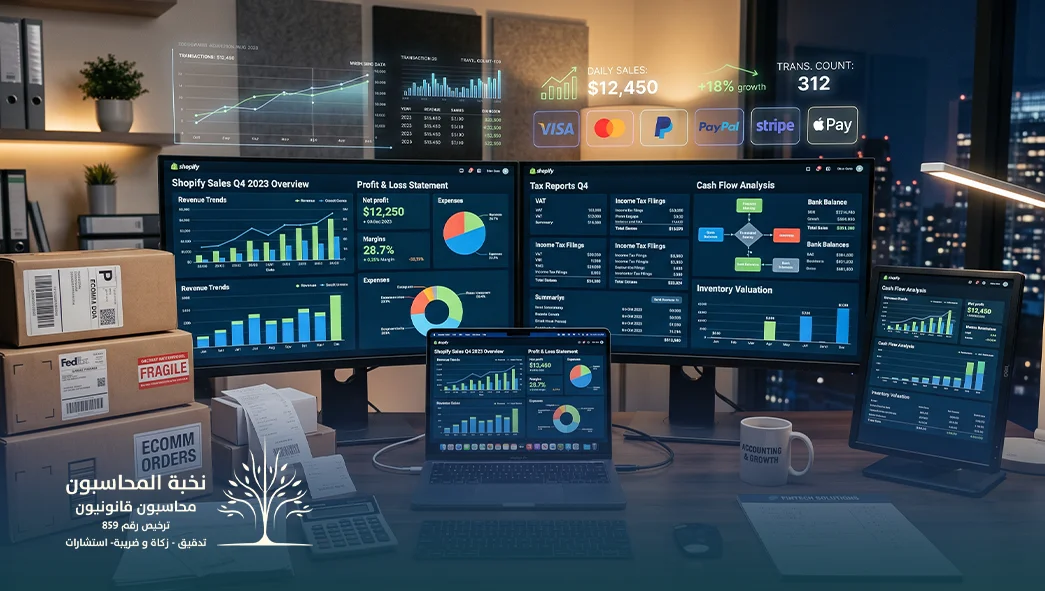
Saudi Arabia’s e-commerce sector is experiencing rapid growth, driven by Vision 2030 and the country’s accelerating digital transformation. Behind every successful online store is a robust accounting system capable of keeping pace with the unique nature of digital commerce. Unlike traditional retail businesses, online stores sell through multiple platforms, serve customers across different locations, process payments through various gateways, and often handle transactions in multiple currencies.
These complexities make traditional accounting methods insufficient. Instead, businesses require a specialized accounting system that complies with the requirements of the Zakat, Tax and Customs Authority (ZATCA) and Saudi Arabia’s e-invoicing regulations.
The real challenge extends beyond recording sales—it lies in building an integrated financial system that produces reliable business insights, ensures tax compliance, and keeps the company prepared for audits at any time.
What Is E-Commerce Accounting?
E-commerce accounting is the process of recording, analyzing, and managing the financial transactions generated through online sales activities.
Unlike traditional accounting, e-commerce accounting relies heavily on digital integration. It not only records sales but also tracks payments received through online payment gateways, shipping expenses, digital marketing costs, and product returns.
Its primary objective is to reconcile sales with bank deposits while ensuring full compliance with ZATCA requirements, particularly regarding VAT and electronic invoicing. This enables store owners to understand their true profit margins rather than relying solely on gross sales figures.
Why Is E-Commerce Accounting Different?
Online businesses operate under conditions that require specialized accounting treatments.
Multiple Sales Channels
A business may simultaneously sell through its own website, Salla, Amazon, and delivery applications. Each platform has different commission structures, settlement schedules, and payment processing methods.
An effective accounting system must consolidate data from all these channels into a single, accurate financial record.
Electronic Payments and Reconciliation
Payments received through payment gateways rarely match total sales exactly due to gateway fees, platform commissions, refunds, and settlement delays.
Accurate reconciliation between recorded sales and actual bank deposits is essential.
Inventory Management Across Multiple Warehouses
Businesses operating under dropshipping models or using third-party fulfillment centers often lack direct visibility into inventory.
Accounting systems must integrate with inventory management software to ensure inventory records remain synchronized with financial data.
B2C vs. B2B Sales
Accounting treatments differ between business-to-consumer (B2C) and business-to-business (B2B) transactions.
B2B sales generally require formal tax invoices linked to the buyer’s tax information, while B2C transactions may be supported by simplified electronic invoices.
Key Components of E-Commerce Accounting
Effective financial management requires careful attention to several critical accounting elements.
Revenue Recognition
Revenue accounting goes beyond recording total sales. Businesses must distinguish between gross sales and net revenue after deducting discounts, promotional offers, and shipping charges.
Every sale should be accurately documented to ensure correct tax reporting.
Operating Expense Management
E-commerce businesses incur operating expenses that differ significantly from traditional retail stores.
These expenses include:
- Payment gateway fees (such as Mada, Apple Pay, Tabby, and Tamara)
- E-commerce platform subscription fees
- Shipping and delivery costs
- Digital advertising expenses
Proper expense classification allows businesses to calculate customer acquisition costs and measure profitability accurately.
Inventory Accounting
Inventory represents one of the most valuable assets for an online store.
Accounting systems should integrate directly with the sales platform to update inventory balances automatically, prevent overselling, and accurately calculate the Cost of Goods Sold (COGS), which is essential for determining actual profit margins.
Payment Reconciliation
Because payment gateways often transfer funds days after a sale and deduct service fees, regular account reconciliation is essential.
Businesses should routinely compare recorded sales with actual bank deposits while accounting for all deductions and commissions.
Financial Reporting
Strategic business decisions rely on timely financial information.
Preparing regular financial statements—including income statements, cash flow statements, and balance sheets—provides management with clear insights into product performance, cash availability, and overall financial health.
Common Challenges in E-Commerce Accounting
System Integration
One of the most common challenges is the mismatch between sales platform data and accounting records.
This issue can be minimized through automated integration between the e-commerce platform and the accounting software or through regular reconciliation procedures.
Refunds and Order Cancellations
Refunds occur more frequently in e-commerce than in traditional retail.
Every refund must be properly reflected in revenue, inventory balances, and VAT calculations.
Foreign Currency Transactions
Businesses accepting payments in multiple currencies should convert transactions into Saudi Riyals using the exchange rate applicable on the transaction date while recording any subsequent exchange differences separately.
Discounts and Promotional Coupons
Promotional discounts and coupon campaigns should be recorded separately rather than being hidden within net revenue.
Proper reporting supports both financial analysis and tax compliance.
Choosing the Right Accounting System for Your Online Store
Selecting the appropriate accounting software is essential for supporting business growth and maintaining compliance.
An effective system should provide:
Direct Platform Integration
The accounting software should integrate seamlessly with your e-commerce platform (such as Salla or Zid) using APIs to automate financial data transfers.
Bank Integration
Automatic bank reconciliation minimizes manual work and reduces reconciliation errors.
E-Invoicing Compliance
The system should be fully compliant with ZATCA’s e-invoicing requirements and support direct integration with government systems.
Advanced Financial Reporting
Interactive dashboards and financial reports should provide real-time insights into profitability, cash flow, and business performance.
Inventory Management
The software should automatically update inventory balances and accurately calculate inventory costs.
Best Accounting Practices for E-Commerce Businesses
Separate Financial Accounts
Maintain separate financial records for each online store or sales channel, even if they operate under the same company.
This makes profitability analysis significantly easier.
Perform Regular Reconciliations
Reconcile platform data, accounting records, and bank statements every month.
Any discrepancies should be investigated immediately.
Document Accounting Policies
Clearly document policies regarding revenue recognition, refunds, and cost allocation.
Well-defined accounting policies simplify audits and staff transitions.
Stay Audit Ready
Maintain organized supporting documentation, including transaction records, platform agreements, screenshots where necessary, and payment confirmations.
How Specialized Accounting Services Help E-Commerce Businesses
Working with accounting professionals is more than an administrative necessity—it is a strategic investment that supports long-term growth.
Professional accounting services help businesses by:
- Organizing the complete accounting cycle from sales to financial reporting
- Preparing accurate financial statements and KPI reports
- Ensuring compliance with VAT regulations and ZATCA requirements
- Supporting business growth through reliable financial insights
- Detecting financial discrepancies early and minimizing operational risks
E-commerce accounting is far more than recording purchases and sales. It provides the financial infrastructure that supports sustainable business growth.
In today’s rapidly evolving digital marketplace, businesses need flexible accounting systems that comply with Saudi e-invoicing regulations, VAT requirements, and provide reliable financial information for strategic decision-making.
If your online store is struggling to consolidate financial data across multiple platforms or prepare for full e-invoicing compliance, Nokhba’s accounting consultants can help. We specialize in developing customized accounting systems for Saudi e-commerce businesses, ensuring full compliance while providing complete visibility into your company’s financial performance.
Frequently Asked Questions
What is e-commerce accounting?
E-commerce accounting is the process of managing, recording, and monitoring all financial, inventory, and tax transactions generated through online sales to produce accurate financial information that supports business decisions.
What is the difference between online store accounting and e-commerce accounting?
The two terms are often used interchangeably. However, online store accounting generally focuses on daily operational activities such as payment gateway reconciliation, while e-commerce accounting covers broader financial, legal, and regulatory aspects of digital commerce.
Are all online stores required to register for VAT?
VAT registration is mandatory when annual taxable revenue exceeds the threshold established by ZATCA. Businesses below the mandatory threshold may register voluntarily if eligible.
How does e-invoicing affect online stores?
Saudi Arabia’s e-invoicing regulations require businesses to issue invoices in approved electronic formats and integrate with ZATCA’s systems, improving tax transparency and reducing compliance risks.
Which financial reports are essential for an online store?
Store owners should regularly review their income statement, cash flow statement, balance sheet, product profitability reports, and sales reports categorized by payment channels.
Is Microsoft Excel sufficient for e-commerce accounting?
Excel may be adequate during the early stages of a business. However, as transaction volumes increase, dedicated cloud-based accounting software becomes essential for reducing errors and supporting e-invoicing compliance.
Is integration with ZATCA mandatory?
Yes. Businesses registered for VAT in Saudi Arabia are required to comply with e-invoicing regulations and integrate with ZATCA according to the applicable implementation phases.
How can I accurately calculate my online store’s net profit?
Net profit is calculated as:
Gross Sales − Cost of Goods Sold (COGS) − Payment Gateway Fees − Shipping Costs − Marketing Expenses − Other Operating Expenses.