
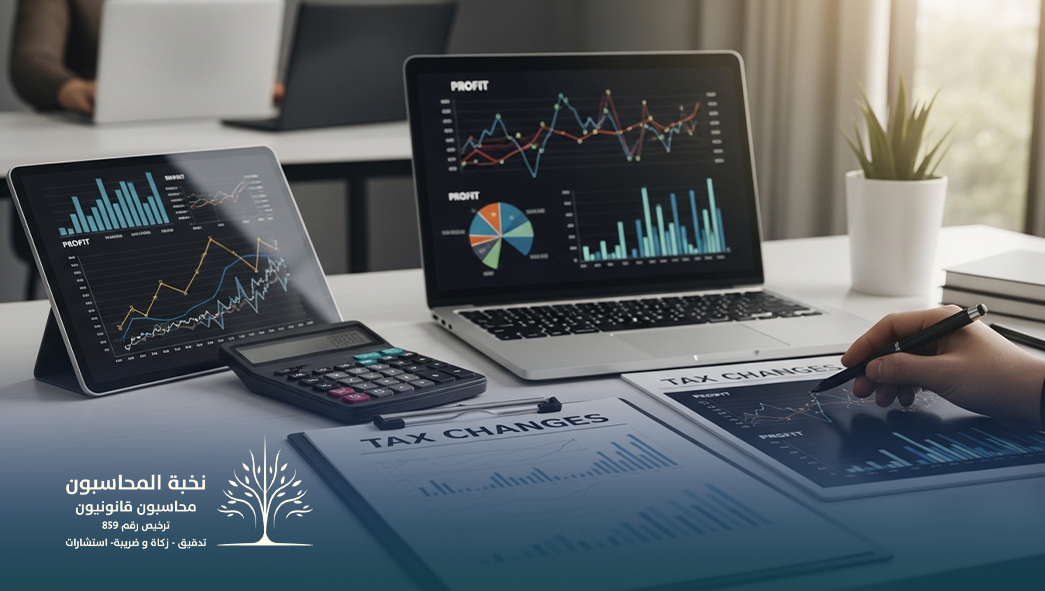
Even if your sales rise this year, your net profit may decline without an obvious reason. In many cases, the issue isn’t operational or marketing inefficiency, but the impact of tax changes on your company’s profits.
Any tax adjustment, no matter how minor it seems, can squeeze profit margins and affect cash flow if not analyzed early. Companies that react late to tax changes pay the price through reduced profits, while proactive companies maintain financial stability and turn changes into calculated opportunities.
In this article, we explain how taxes affect a company’s cash flow and outline practical strategies to manage tax changes intelligently to protect your profits.
How Do Tax Changes Affect Your Company’s Profits?
A tax change does not only appear as a separate line item in financial statements; its impact extends to the entire profitability structure. Many management teams view taxes as a number deducted at the end of the period, while the reality is that any adjustment—whether in rates, calculation methods, or compliance requirements—reshapes the equation of costs, pricing, and cash flow simultaneously.
To understand this practically, consider the nature of the change, which may involve:
-
Tax rates
-
Calculation methods
-
Additional compliance requirements
-
Conditions for deductions or exemptions
Despite the type of adjustment, the outcome is often the same: direct pressure on profit margins.
Where Does the Impact Show Up in the Company?
-
Increased Operating Costs
Any tax increase represents an additional expense that must be absorbed—either by the company’s profits or passed on to customers through price adjustments. -
Higher Pricing Sensitivity
If pricing policies are not adjusted intelligently, the company may absorb the difference from its profit margins without an immediate drop in sales. -
Erosion of Competitive Advantage
A competitor with more efficient tax planning may maintain lower prices and higher profitability simultaneously, gaining a clear market edge. -
Silent Losses from Unutilized Deductions
Any change in deduction or exemption rules, if not understood early, can reduce net profits without being immediately apparent in reports.
Ultimately, understanding the impact of tax changes on profits requires analyzing the entire value chain—from supply and operations to pricing and collections—to ensure sustainable and stable profit margins.
How Taxes Affect Company Cash Flow
To understand taxes’ effect on cash flow, one must differentiate between accounting profits and actual liquidity. Profits may look healthy on paper, yet the company may face real cash pressures due to fluctuating tax obligations or tight payment deadlines.
Key ways taxes affect cash flow:
-
Daily liquidity pressure
Tax changes, whether rate increases or payment date adjustments, require allocating larger amounts in short periods, reducing the company’s flexibility to cover operational expenses. -
Impact on financing operations and projects
Tax obligations may limit the ability to fund salaries, supply materials, or invest in new projects if financial planning is not done in advance. -
Unexpected cash gaps
Delays in recovering tax refunds can create sudden funding gaps, affecting financial stability and putting management under pressure even if profits appear strong on paper.
Smart Cash Flow Management Strategies
-
Forecast future tax obligations accurately.
-
Schedule payments strategically to avoid sudden cash pressures.
-
Allocate dedicated tax reserves.
-
Integrate tax planning into daily cash flow management strategies.
In this way, taxes become part of a comprehensive business plan rather than just a financial obligation, giving your company greater stability, predictable liquidity, and the confidence to make expansion decisions.
Strategies for Handling Tax Changes Intelligently
Instead of waiting for negative impacts, companies can adopt strategies to turn tax changes into manageable factors:
-
Continuous monitoring of regulatory updates rather than reacting after implementation.
-
Immediate impact analysis for each new change to determine effects on profits, cash flow, and pricing.
-
Restructuring operations or contracts if necessary to align with regulations and enhance tax efficiency.
-
Review pricing policies to absorb potential cost increases without losing competitiveness.
-
Engage specialized experts for long-term strategic insight instead of relying on temporary fixes.
These strategies not only minimize negative impacts but also enhance the company’s flexibility in facing future changes.
Tax Changes as a Strategic Factor in Growth Decisions
Taxes are not just a financial obligation; they are a key factor influencing every strategic step. Whether expanding, investing new capital, or onboarding partners, any tax change can reshape the financial feasibility of projects.
Including tax change analysis in feasibility studies for expansion is vital. Companies that integrate the tax dimension into strategic planning are more capable of:
-
Making informed decisions based on precise figures
-
Protecting targeted profits and reducing unexpected financial risks
-
Turning taxes from a burden into a planning tool that supports sustainable and smart growth
Frequently Asked Questions
How do I know if my company is at risk from a tax change?
If no financial analysis is conducted after a regulatory update, there’s a likelihood of unaccounted impact.
Can the financial plan be adjusted after a change?
Yes, but early adjustments before implementation are more efficient and cost-effective.
Do tax changes affect small businesses as much as large ones?
The relative impact can be greater on small businesses due to limited cash reserves.
Conclusion
Ignoring the impact of tax changes on your company’s profits can gradually erode margins without clear visibility. Understanding how taxes affect cash flow and applying strategies to manage changes proactively and professionally gives you greater control over financial stability and enhances competitiveness.
Don’t leave your profits at the mercy of regulatory fluctuations. Contact Nukhbat Al-Muhasiboon today and let our experts help you build a proactive plan that protects your profits and supports sustainable business growth with confidence and long-term stability.