
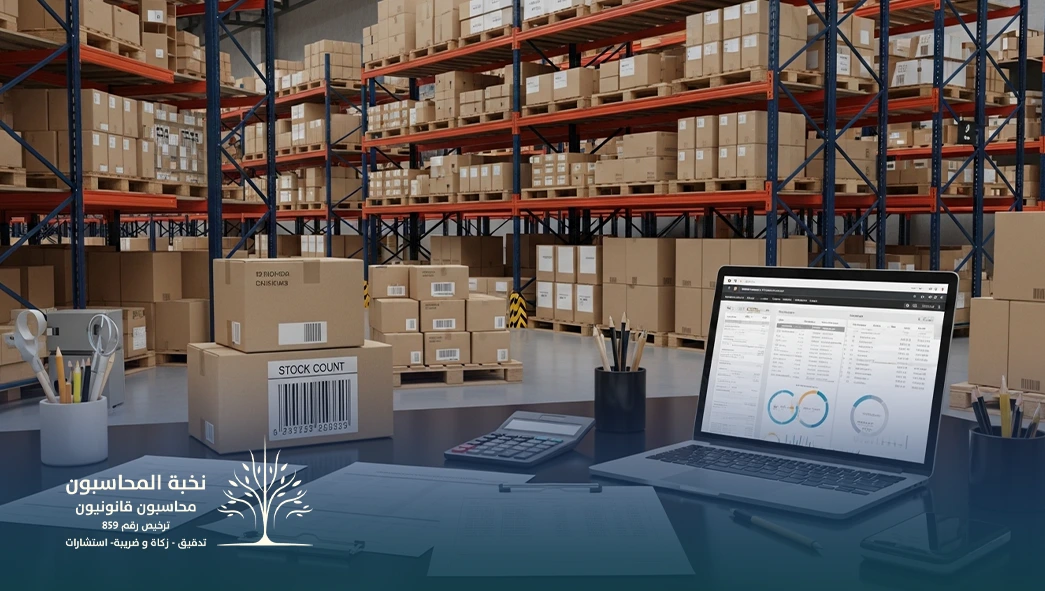
In the world of commerce, inventory represents capital frozen on shelves; it can either be managed intelligently to transform into cash flows and profits, or left unmanaged, turning into losses due to damage or obsolescence. Inventory management is no longer just about storing goods—it has become a vital artery in modern financial management.
In this article, we explore the details of inventory accounting, reviewing valuation methods, challenges, and how precise accounting control contributes to protecting the capital of Saudi companies and enhancing profitability.
What Is Inventory Accounting?
Inventory accounting is a financial control system aimed at accurately tracking the movement of goods (inflows and outflows) and determining their financial value at any given moment. It is one of the most important components of current assets on the balance sheet, as its accuracy directly impacts the cost of goods sold and net profit.
Types of Inventory in Companies
The classification of inventory varies depending on the nature of the business. In industrial and commercial companies, inventory can be divided into three main types:
- Raw materials: Basic components purchased for use in production and not yet processed.
- Work in progress: Goods that have entered the production process but are not yet completed, including material costs, direct labor, and overhead.
- Finished goods: Final products ready for sale. At this stage, inventory shifts from an asset on the balance sheet to cost of sales in the income statement once sold.
Inventory Valuation Methods: How to Choose the Right One?
There are several accounting methods for inventory valuation, and the choice affects taxes and reported profits:
- FIFO (First In, First Out): Assumes that the earliest purchased goods are sold first. This method reflects inventory values closer to current market prices.
- Weighted Average: Calculates the average cost of all units available for sale. It is the most balanced and widely used method.
- Specific Identification: Used for unique and high-value items (such as jewelry or cars), where each unit’s cost is tracked individually.
- LIFO (Last In, First Out): Assumes the most recently purchased goods are sold first. (Note: This method is not permitted under IFRS standards applied in Saudi Arabia.)
Importance of Inventory Accounting in Financial Management
Inventory accounting plays a fundamental role in maintaining financial balance within an organization by achieving the following:
- Accurate financial statements: Ensures correct reporting of assets and cost of sales, preventing misleading financial reports and ensuring tax and zakat compliance.
- Cost control: Helps monitor storage costs, reduce waste, and detect shortages or theft promptly.
- Improved cash flow: Prevents overstocking that ties up liquidity while avoiding stockouts that may lead to lost sales opportunities.
- Decision support: Provides data on inventory turnover and high-demand items to support informed purchasing decisions.
Challenges Facing Inventory Accounting
Despite technological advancements, inventory accounting still faces several operational and financial challenges:
- Rapid price changes: Inflation requires continuous updates to pricing and valuation policies.
- Human errors in stocktaking: Incorrect data entry may lead to poor decisions or false shortages.
- Obsolescence risk: Long storage periods reduce product value, turning inventory into idle stock.
- System integration: Difficulty in integrating inventory systems with accounting or ERP systems in real time.
Therefore, engaging a certified public accountant is essential to address these hidden challenges and build a robust control system.
Golden Tips to Improve Inventory Accounting Management
- Apply segregation of duties: The person recording transactions should not be responsible for inventory custody.
- Conduct periodic and surprise stock counts.
- Set a minimum safety stock level.
- Invest in continuous employee training.
- Seek professional consultation from a certified public accountant.
Proper inventory management not only preserves capital but also supports financial stability and sustainable growth. Understanding inventory accounting principles and applying best practices transforms inventory into a competitive advantage.
If you are looking for a certified public accountant to design a professional inventory accounting system that ensures data accuracy, we are here to help.
Contact Nokhbat Al Mohaseboon today and enhance your inventory management efficiency.
Frequently Asked Questions About Inventory Accounting
How does inventory valuation affect zakat and income?
The value of ending inventory directly impacts net profit. Higher ending inventory reduces cost of goods sold and increases accounting profit, affecting zakat and tax bases.
What is the difference between periodic and perpetual inventory systems?
Periodic inventory is updated at specific intervals (usually year-end), while perpetual inventory records every transaction in real time, providing accurate current balances.
What is the proper accounting treatment for damaged inventory?
Damage should be documented officially, inventory value reduced, and the loss recorded as an expense in the income statement, while determining responsibility.
Can inventory valuation methods be changed annually?
Accounting standards (such as IFRS) require consistency. Changes are allowed only if they provide more accurate representation and must be disclosed with their financial impact.