
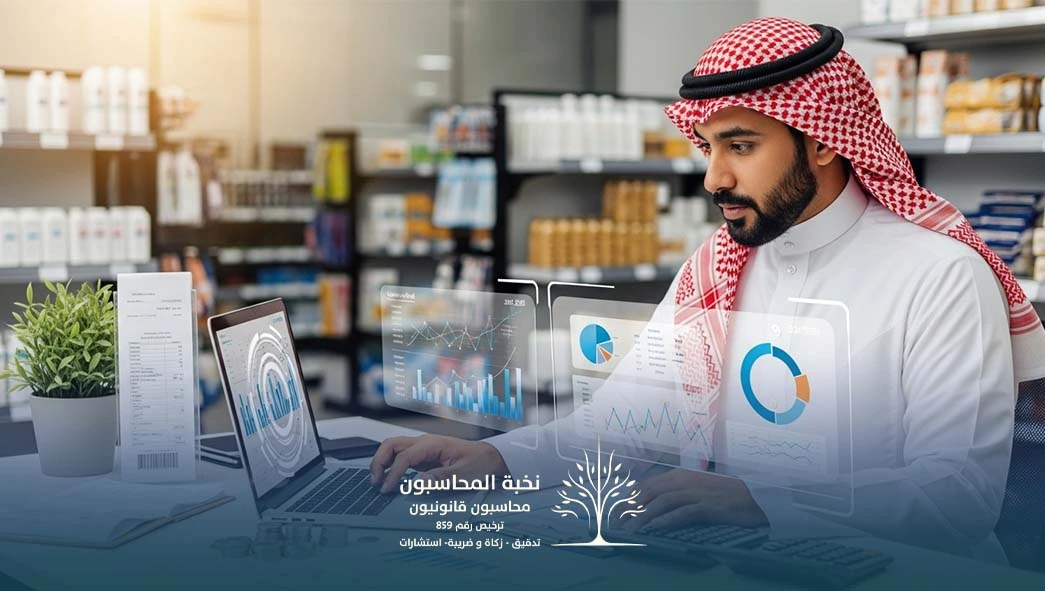
Your store may be crowded with customers every day, and dozens or even hundreds of invoices may be issued, yet you still feel that the profits do not reflect this high level of activity. Here lies the problem faced by most retail businesses: a large number of transactions does not necessarily mean accurate results. A small recurring error in recording a sale, calculating the cost of an item, or managing inventory can consume part of the margin without clearly appearing in superficial reports.
For this reason, accounting is no longer just about recording entries; it has become an analytical and supervisory system. This is precisely where the importance of retail accounting services becomes clear, as they connect daily sales activity, cost of goods, inventory, and cash flow into one clear picture that enables management to make accurate and quick decisions.
In the following lines, we will review the most important aspects that retail businesses need in order to maintain their profits and grow steadily in a highly competitive market.
First: Sales analysis as the starting point for building sustainable profitability
Many stores measure their success solely by the volume of sales, but real profitability lies in the fine details of every sales transaction. Through retail accounting services, each transaction can be analyzed and linked to its direct and indirect costs, revealing the true margin for each product and the impact of discounts and promotions on net profit.
Implementing an integrated sales accounting system allows management to distinguish between products that generate real profits and those that consume capital without delivering a suitable return. Accurate analysis also provides the ability to:
-
Adjust prices based on the actual performance of each product.
-
Restructure promotional offers to avoid profit loss.
-
Improve purchasing and ordering strategies in line with inventory turnover rates.
The difference between a store that sells a lot and a store that profits intelligently lies in having a precise analytical reading of every number, turning daily data into tools for strategic decisions that increase profitability and business sustainability.
Second: Integration of point-of-sale systems with the accounting system to control daily revenues
Retail accounting services rely on real-time integration between the point-of-sale system and the accounting system to ensure that transactions are recorded instantly and that data remains accurate. Activating this system allows for:
-
Matching cash and electronic collections with daily sales.
-
Detecting deviations and discrepancies early before they accumulate.
-
Analyzing cashier performance and measuring peak times accurately.
-
Monitoring return rates and addressing them quickly.
Real-time data gives management the ability to make immediate and informed decisions, transforming daily oversight into a shield that protects profits and reduces invisible losses, ensuring that the store operates efficiently with continuous profitability.
Third: Accounting-based inventory management and achieving balance between availability and liquidity
Effective inventory management does not stop at recording items; it includes analyzing product turnover and identifying products that consume the most capital compared to their profitability.
With retail accounting services, stores can:
-
Track every unit of inventory from purchase to sale.
-
Measure the impact of inventory on capital and cash flow.
-
Identify accumulated goods that require repricing or special offers.
-
Improve future purchasing decisions based on accurate data.
This approach transforms inventory from a simple product list into a tool for improving liquidity and increasing returns, while ensuring that capital is not frozen in unprofitable goods.
Fourth: Building an internal control system that enhances data accuracy and reduces risks
Internal control is the primary shield that protects any store from financial leakage. Any gap in sales or inventory operations can lead to significant losses in the long run.
Retail accounting services support stores through:
-
Segregation of duties among employees to ensure double verification.
-
Daily review of sensitive transactions such as cash and electronic sales.
-
Automatic alert systems to detect irregularities.
-
Detailed reports for managing the daily performance of each branch or point of sale.
Accurate control prevents the accumulation of errors and protects profits from unnoticed leakage, while also providing reliable data for sound managerial decision-making.
Fifth: Managing the financial performance of branches within a unified system
Expansion in the retail sector requires precise central management to ensure that all branches adhere to the same standards. With retail accounting services, companies can:
-
Monitor the performance of each branch in real time.
-
Standardize store accounting systems to facilitate control and analysis.
-
Analyze differences between branches and take immediate corrective actions.
-
Manage cash and inventory flow across different branches in a balanced way.
This ensures that every branch operates efficiently and profitably without the headquarters losing control over daily operations.
Sixth: Tax compliance as part of long-term financial stability
Tax compliance is a key element in ensuring the continuity of retail businesses. Errors in recording sales or inventory can lead to unexpected violations and fines. Therefore, retail accounting services provide practical solutions that include:
-
Accurately recording all sales in the accounting system.
-
Linking transactions with tax systems to avoid errors.
-
Periodic tax reports to review performance and ensure compliance.
-
Supporting the management team in preparing declarations and legal reports.
The result is reduced financial and legal risks and guaranteed long-term stability for your business.
Why choose Elite Accountants as a financial partner for your business?
Choosing an accounting partner is not a routine administrative decision; it is a strategic step that affects the stability of your entire business. At Elite Accountants, we do not provide traditional reports; we build an integrated system that understands the nature of the retail sector and its daily challenges. We rely on detailed analysis of sales, inventory, and costs, while designing control mechanisms that match the size of your business, whether you manage a single store or a network of branches. We focus on transforming data into clear performance indicators that help you make accurate decisions based on real numbers.
Frequently Asked Questions
Can liquidity be improved without increasing capital?
Yes. By improving inventory management, reducing overstocking, and controlling the collection cycle, frozen liquidity can be released without the need for additional financing.
What indicators should I monitor monthly in the retail sector?
The most important indicators include gross profit margin, inventory turnover rate, the ratio of expenses to sales, and the return rate.
Do small stores need an advanced system like large retail chains?
Yes, because the margin of error in small stores has a greater impact on capital. Therefore, they need a precise system that protects their profits from the beginning.
Conclusion
With retail accounting services from Elite Accountants, sales, inventory, and point-of-sale data are transformed into a strategic tool that drives profitability, protects earnings, and ensures legal compliance.
Contact us today to obtain a customized consultation and turn your accounting into a real growth driver for your store.