

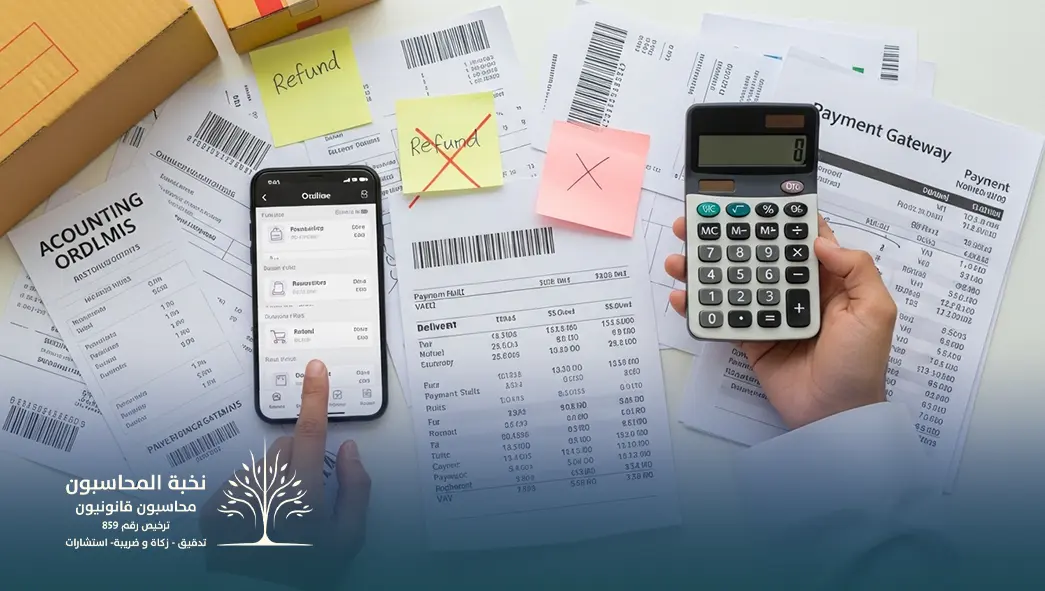
Accounting departments in e-commerce companies face a unique challenge: financial transactions flow through multiple unsynchronized channels. A sale may happen today, payment arrives days later through a payment gateway that deducts its commission immediately, while refunds may reverse entries a week later.
This level of complexity makes relying on spreadsheets or traditional accounting systems insufficient. The difference between an e-commerce company with a well-organized accounting system and another suffering from weak financial management is the ability to grow without accumulating errors that may lead to penalties or poor business decisions based on inaccurate figures.
In this article, we highlight the most common accounting problems in e-commerce stores and how to build a strong financial system for your online business.
What Makes E-Commerce Accounting Different from Traditional Businesses?
The accounting nature of digital commerce differs significantly from physical stores due to several factors:
Multiple Payment Methods
Traditional stores mainly rely on cash or POS systems, while e-commerce businesses deal with payment gateways, digital wallets, and bank transfers—each with different fees and settlement cycles.
High Volume of Daily Transactions
Online stores may process hundreds or thousands of orders daily, requiring accounting systems capable of handling large volumes of financial data accurately.
Multiple Sales Channels
Many merchants sell through websites, social media platforms, and global marketplaces such as Amazon or Noon, requiring consolidated financial reporting.
Fast Revenue and Refund Cycles
Refunds and exchanges occur frequently, making real-time reconciliation critical for accurate balances.
Major Accounting Problems in E-Commerce Stores
1. Multiple Payment Gateways
Online stores receive payments through credit cards, Mada, Apple Pay, and bank transfers.
Problem:
Each payment gateway charges different fees and follows different settlement schedules.
Impact:
Difficulty reconciling actual sales with bank balances.
2. Refund and Compensation Processing
Refund rates are much higher in e-commerce than in traditional retail.
Problem:
Gateway fees are often non-refundable, in addition to reverse shipping costs.
Impact:
Incorrect accounting may create misleading profit reports.
3. E-Commerce Tax Challenges
Tax compliance is one of the biggest accounting problems in e-commerce stores.
Problem:
Applying VAT correctly based on customer location and product type while complying with Saudi e-invoicing regulations.
Impact:
Exposure to penalties due to inaccurate tax returns.
4. Managing Shipping and Logistics Costs
Shipping and warehousing expenses are variable and difficult to track accurately.
Problem:
Mixing customer shipping charges with actual logistics expenses.
How to Successfully Manage E-Commerce Store Accounts
First: Automate Financial Transactions
Integrate your store platform directly with a cloud accounting system to reduce manual errors.
Second: Separate Gross Sales from Net Collections
Your accounting system should separately record:
- Total sales value
- Payment gateway commissions
- Net transferred amount
Third: Perform Inventory Audits
Regular reconciliation between actual and digital inventory prevents operational losses.
Fourth: Comply with E-Invoicing Requirements
Ensure your invoices include QR codes and all required tax data while remaining fully integrated with ZATCA systems.
How Nukhbat Al-Muhasiboon Supports E-Commerce Businesses
We help online merchants focus on growth instead of accounting complexity through:
- Accounting system integration
- VAT compliance and tax filing
- Profitability analysis
- Financial and tax expansion advisory
A successful online store is not only about selling more—it is about having a financial system that tracks every riyal accurately.
Frequently Asked Questions
What are the most common accounting problems in e-commerce stores?
Inaccurate transaction recording, tax errors, weak account management, and reconciliation difficulties.
Why is e-commerce accounting different?
Because of digital payment systems, high transaction volume, and reliance on automated platforms.
How do accounting systems help online stores?
They automate transaction recording, reduce errors, and improve reporting quality.
When does an online store need accounting consultation?
When sales grow, financial discrepancies increase, or tax processes become complex.