
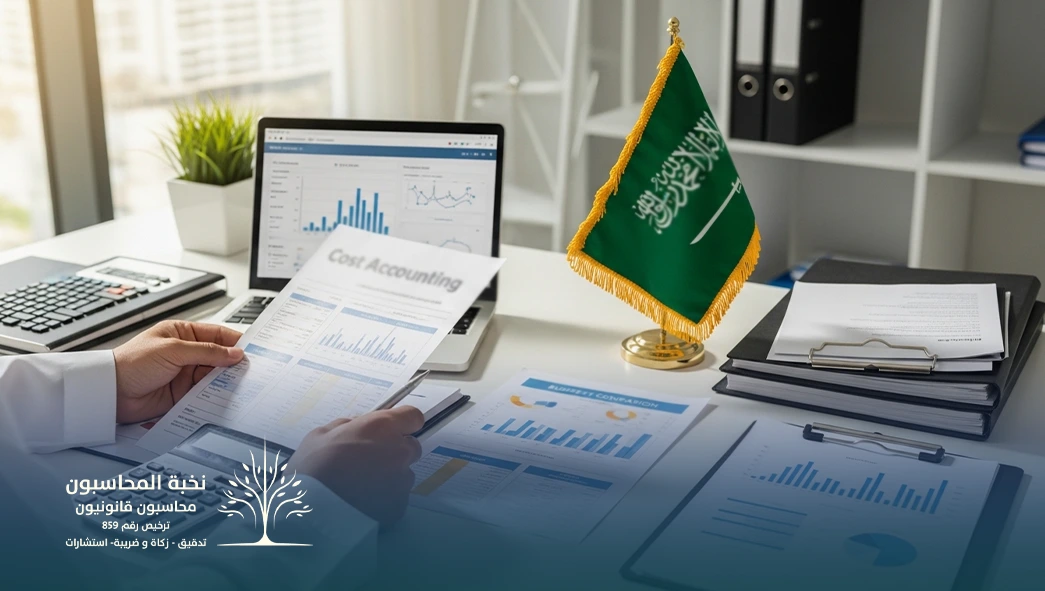
There are many companies that achieve massive sales, yet struggle with low profits or even losses. The reason for this is not the market or the product, but rather the absence of a clear vision regarding costs.
This is where the true role of cost accounting emerges—not as a traditional accounting tool for recording expenses, but as an integrated analytical system that helps management understand where money is being spent and how it can be used more efficiently to achieve maximum returns. Through this understanding, decisions shift from personal judgment to data-driven choices.
In this article, we will go beyond traditional definitions and take a practical deep dive into the concept of cost accounting. We will also explain how it can be used as a strategic tool to improve financial performance, reduce waste, and increase profitability in a tangible way.
What Is Cost Accounting and Why Is It a Strategic Tool?
Cost accounting is one of the most important branches of accounting, focusing on analyzing and tracking expenses related to production or service delivery. However, its real value lies not in merely collecting data, but in transforming that data into actionable insights for decision-making.
For example, when a company manufactures a product, cost accounting does not stop at calculating raw material costs. Instead, it analyzes every cost component—from labor and operational expenses to indirect costs—providing a comprehensive picture that helps management accurately evaluate performance.
Types of Costs in Accounting and Their Impact on Decisions
To better understand cost accounting, it is essential to explore the different types of costs, as proper classification is the first step toward accurate analysis.
Direct and Indirect Costs
Costs are divided into direct and indirect categories, which is one of the most critical classifications companies rely on.
Direct costs are those that can be directly linked to a specific product, such as fabric in a clothing factory or raw materials in a food production facility. Indirect costs, on the other hand, are not easily tied to a single product, such as rent, electricity bills, or administrative salaries.
The importance of this classification lies in helping management identify the true sources of costs. Some companies focus only on direct costs and overlook indirect ones, leading to inaccurate pricing and unexpected losses.
Fixed and Variable Costs
Another important classification includes fixed and variable costs. Fixed costs remain constant regardless of production volume, such as rent, while variable costs fluctuate depending on production levels, such as raw materials.
This classification is particularly important when making decisions about increasing or decreasing production, as it helps assess the impact on total costs.
Standard and Actual Costs
Standard costs are pre-determined estimates used for planning, while actual costs represent what is truly spent. Comparing the two helps identify variances and analyze their causes.
Objectives of Cost Accounting and Its Role in Improving Efficiency
The objectives of cost accounting encompass a set of vital functions that enhance both financial and operational performance.
First, it helps determine the true cost of products and services, enabling companies to set competitive and profitable prices. Second, it supports financial planning by providing accurate data for budgeting.
More importantly, it plays a key role in performance analysis, helping identify weaknesses in production processes, such as material waste or low labor efficiency.
Calculating Production Cost: How and Why It Matters
Calculating production cost is one of the most important tools provided by cost accounting, as it determines the total cost of producing a single unit.
This process includes three main components:
- Raw material costs
- Labor costs
- Manufacturing overhead
However, the real value lies not just in the calculation, but in how the results are used. For instance, if a company discovers its production costs are higher than competitors, it can explore solutions such as reducing waste, negotiating with suppliers, or improving operational efficiency.
Imagine a company produces a product at a cost of 100 EGP and sells it for 110 EGP. On the surface, it appears profitable. However, if there are unaccounted costs like maintenance or depreciation, those profits may actually turn into losses without management realizing why.
Common Mistakes in Applying Cost Accounting
Despite its importance, many companies make mistakes that reduce the effectiveness of cost accounting.
One of the most common errors is ignoring indirect costs. Some companies rely only on direct costs when pricing, leading to inaccurate profit estimates. Additionally, relying on outdated or incomplete data results in poor decision-making.
Another mistake is failing to analyze variances between expected and actual costs. Some companies simply record numbers without attempting to understand the reasons behind discrepancies.
Perhaps the most dangerous mistake is making pricing decisions without a comprehensive cost analysis, which can lead to significant losses despite increased sales.
The Role of a Cost Accountant in Decision-Making
A cost accountant plays a strategic role within an organization. Their work goes beyond recording data to analyzing it and providing recommendations that improve performance.
They monitor expenses, analyze variances, and prepare reports that reflect the true financial status of operations. They also contribute to developing plans that reduce costs without compromising product quality.
In many cases, the cost accountant is a key figure relied upon by management when making critical decisions such as expansion, production reduction, or entering new markets.
How to Use Cost Accounting to Actually Increase Profits
To turn cost accounting from a theoretical concept into a practical tool, companies can follow clear steps:
- Regularly analyze all cost components
- Accurately classify costs into direct and indirect
- Continuously monitor variances
- Improve operational efficiency
- Make pricing decisions based on real data
Conclusion
Ultimately, no company can achieve sustainable success without a deep understanding of its costs. Cost accounting is not just an accounting tool—it is a comprehensive system that helps uncover weaknesses, improve performance, and support more accurate financial decisions.
If you aim to implement this system effectively within your company, collaborating with a specialized firm can save significant time and costly trial-and-error. Therefore, reaching out to a professional accounting firm is a smart step toward gaining practical insights and expert solutions that help control costs and enhance profitability with confidence.
FAQs
Can cost accounting be applied without an electronic accounting system?
Yes, it can be applied manually in small businesses. However, using electronic systems provides greater accuracy, faster analysis, and reduces human error.
What is the best way to reduce costs without affecting quality?
The best approach is to analyze operational processes and identify waste—such as reducing material loss or improving labor efficiency—rather than lowering product quality.
When does a company need a specialized cost accountant?
Companies need a cost accountant when they begin to scale or when they struggle to identify the reasons behind declining profits despite increasing sales.